
For decades, the University’s Astronomy Department has hosted public outreach programs at its home, the Van Vleck Observatory — that is, until the COVID-19 pandemic forced the observatory to close its doors. This fall, new efforts by students, faculty, and community members have led to the resurrection of public programming in full swing.
The observatory currently hosts weekly Space Nights every Wednesday from 8 to 9 p.m. These include “mini-talks” by students and telescope-observing when the sky is clear. The Astronomy Department also hosts monthly Kids Nights, with programming tailored to children in elementary school. In addition to this regular programming, a number of extra special events have been put on this semester and are planned for next semester.
Astronomy Department Chair Meredith Hughes leads much of this work. When Hughes first arrived at the University in 2013, the Astronomy Department ran an active outreach program that relied on volunteer labor and depended on the weather. Hughes has played a major role in expanding the outreach program, including paying students for their contributions.
“Partly that was a recognition that it is real work,” Hughes said. “Partly that is an equity issue, where I wanted to make sure that it wasn’t only the privileged students who didn’t need to hold down jobs who could work in our outreach program. Students who had to work steady jobs could count on this as part of their work-study income.”
Hughes also worked on making programming more regular, even when cloudy or rainy weather prevented the Astronomy Department from using its telescopes.
“The other change was that I wanted it to be more rain or shine, because there’s a fair amount of work in outreach and education circles that shows that random acts of public outreach don’t have as much impact as something that’s more regular, sustained, and predictable,” Hughes said.
Hughes received a National Science Foundation grant to fund the program this summer. Additionally, she and other Astronomy Department faculty members lead annual pedagogical seminars to teach astronomy majors to give educational talks to the public.
“One of the things that I was really interested in was taking the opportunity that we have here, which is a big visible observatory in the middle of campus in the middle of a pretty large city—actually, we’re walking distance from Main Street,” Hughes said. “That’s a great opportunity to get people in our doors and get them excited about space.”
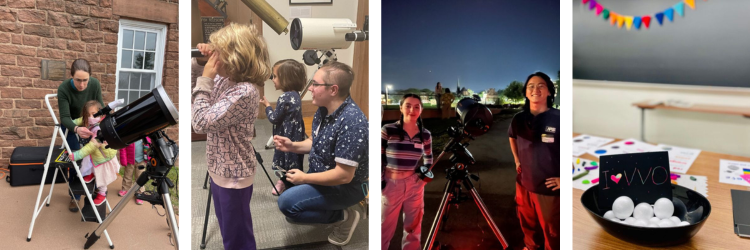
This grant, as well as funding from other sources, has allowed the Astronomy Department to expand its programming with special events, including observing a partial solar eclipse on October 14 in collaboration with Russell Library. Head of Russell Library’s children’s department Amy Slowik worked with the department to acquire 3,000 eclipse glasses, bilingual Spanish/English educational materials, and a solar telescope for the event. The observatory plans to host another event in the spring for the upcoming total solar eclipse on Monday, April 8.
“We still have several thousand eclipse glasses to hand out [at] Foss Hill,” Slowik said. “We’ll have the bilingual materials there again, [and] Russell Library will be there signing people up for library cards and will bring books on space. That’s expected to be much bigger than the [October solar eclipse] event.”
The observatory also hosted the first-ever StarGayzing event on October 12, which sought to bring queer people from Wesleyan and Middletown together to learn more about astronomy. The event was organized by astronomy graduate student Rewa Bush, MA ’24.
“Over the summer, we re-kick-started the [Astronomy] Ethics and Equity Journal Club,” Bush said. “We were doing a reading in June for Pride Month about challenges that LGBTQ astronomy students and faculty face. We were brainstorming what we could do as a department… I don’t know where the idea came from, but I just had this notion of a StarGayzing event in my head. I’m like, you know what, I’m just going to propose it. What if we had an event that specifically built community among queer folks in Astronomy? And, you know, help people have an encounter with outer space in a welcoming and warm environment.”
Bush explained that her passion for creating inclusive spaces within astronomy stems from her experiences as an early astronomy enthusiast.
“I loved astronomy as a kid but was always the only woman in the room and felt that it was a toxic environment,” Bush said. “That’s why I didn’t pursue astronomy until later in life.”
Bush planned the event with the Astronomy Department’s administrative assistant Stefanie Dinneen and astronomy major Victoria Dozer ’24, along with help from other students.

“We had mini talks so that it was partly educational,” Bush said. “We had the telescopes open. We thought it would be cool to have a planetarium show queering the Greek mythology behind the constellations, because it turns out that the Greeks were super gay. And we sourced some food from a local queer-owned bakery, Tony’s Flour Shop. Tony is absolutely delightful and was excited to work with us.”
The event was made possible by support from the Resource Center, the Office of Equity and Inclusion, and the Middletown Pride Commission. The night was such a success that plans are already in the works to host it again in future years.
“The department completely jumped on board and decided it should become an annual event,” Bush said. “We thoroughly documented the whole process of planning it, getting funding, creating the presentations, designing mini queer science fiction zines, etc. so that it will be easy to implement next year and future generations of students can keep iterating and making it better.”
Beyond public events, the Astronomy Department is also engaged in advocacy. A group of astronomy students, including Bush, have taken an interest in dark skies activism.
“Light pollution doesn’t just harm astronomers who are trying to make observations,” Bush said. “Migratory animals are really hindered by not being able to navigate by the Milky Way, and people’s sleep cycles are very damaged by light pollution. Indigenous communities have stored [a lot of] their historical knowledge in the sky, and then are losing access to that because of light pollution. So for many reasons, this issue is important to different stakeholders.”
Although light pollution is a widespread problem, the group is hopeful that it can effect change.
“We’re inspired by the fact that light pollution is an incredibly solvable problem,” Bush said. “The solutions are simple—we just need to implement them. It’s something that we can directly impact on our campus.”
The group is looking to plan an event in the spring with educational talks about light pollution and dark sky advocacy at the University. Overall, this fall’s outreach work is indicative of the Astronomy Department’s continued commitment to engaging with the wider community and excitement for creating new traditions.