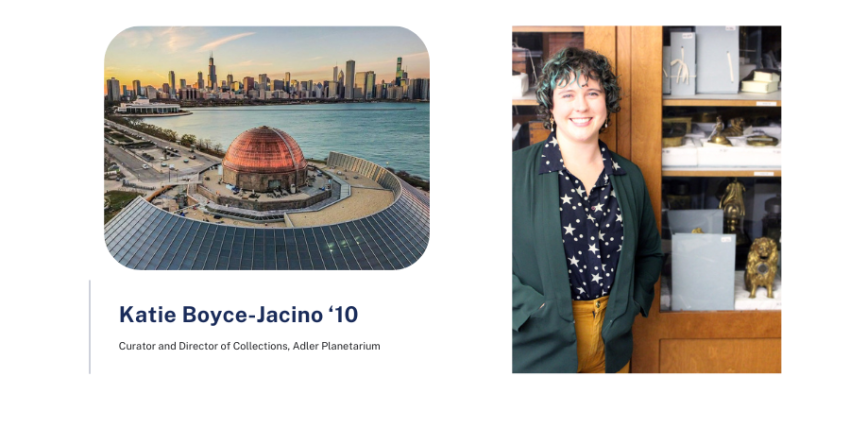
There is an astronomical navigation book in the collection at the Adler Planetarium that has been through the ringer. As Dr. Katie Boyce-Jacino ‘10, Curator and Director of Collections at the Adler Planetarium in Chicago, tells me, inside of its saltwater-damaged cover lie pages upon pages of numerical information for navigating on the open sea. On its own, this book gives us an understanding of what tools sailors had for navigation in the 19th century; however, the writings and drawings between the lines of numbers tell a much more interesting story.
In dozens of different handwritings throughout the book are scribbles and calculations done by the different sailors who owned it, with each of their names signed on the inside cover. One notable owner went by Henry–there are many pages with his name signed in different fancy lettering, many pictures of boats, some “really bad poetry”, and some pages with drafts of love letters to send back home. When these notes in the margin are considered, we can learn so much more about the intimate history of these objects and these sailors. In uncovering these small stories about common people, the history of astronomy transitions from something being produced in lofty observatories to stories about common people.
The Adler Planetarium has an extensive and impressive collection of objects that highlight the history of astronomy, and Dr. Boyce-Jacino oversees that collection. As curator of that collection, her job is to “take those objects, those amazing historical objects, and tell a story about them, and tell a story about the history of astronomy that feels accessible and interesting and engaging to an audience by telling it through objects.”
When deciding what objects go on display in cases, there are a few considerations that she makes. First, there are the physical considerations: Is the object durable enough to be put on display? What temperature and humidity does the object need? What light level is ideal so that the object can be seen and not damaged? Then, there are the curatorial considerations: what other objects are in the space? Do they tell a story together? Does the object have to sit alone and tell a story by itself? By taking all these factors into account, she and the rest of the team at the Adler can tell intricate and elaborate stories using their collection.
But what stories get told? Dr. Boyce-Jacino explained that the history of astronomy has historically been focused mostly on European and Arabic astronomy, in a sort of great overarching narrative about the discovery of the stars. These narratives often focus on grand discoveries that are primarily driven by men and by the grand institutions that fund them. However, by escaping that narrative and thinking about astronomy not just as an institutional thing but as a science that everyone does, the story becomes a lot more diverse. This escape from a grand narrative lets museums tell stories about “peasants in Renaissance Europe, looking at the sky and making almanacs for planning out when to plant their crops [and] astrologers in India planning out Vedic astrological birth charts”.
Throughout our interview, Dr. Boyce-Jacino underlined the point that the approach to storytelling and historytelling that she and the Adler practices shows that there have always been diverse voices in STEM, even if they are not necessarily visible to the broader narrative and stories. Despite it often feeling like it may be hopeless to make fields like astronomy more accessible, telling these stories shows us that there are always people making inroads into the discipline that we can’t necessarily see.