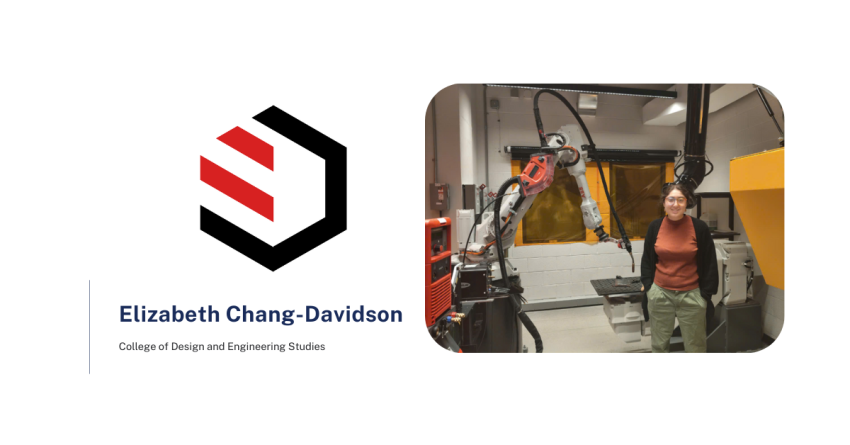
Professor Chang-Davidson arrived at college with a plan: to double major in mechanical engineering and math, a combination which was shaped by interests she had carried throughout high school. During her high school years, she spent long afternoons and evenings working with her robotics team, building and troubleshooting whatever problems arose. In the summers, she went to math camps where she learned, as she puts it, “lots of weird math.” Pursuing both fields felt natural, and in the end she completed the exact double major she had imagined.
Although she enjoyed programming, what ultimately drew her toward mechanical engineering was something more tactile. She liked working with objects she could hold in her hands. “I wanted to build stuff that I could see and touch,” she explains. Engineering also offered the chance to build things that would be tangibly useful.
Discovering the manufacturing bottleneck
Internships in college gradually pushed her toward manufacturing. While working at an aerospace company, she saw how creative designs could be brought to a halt simply because no one could fabricate the parts. At one point the team needed custom carbon-fiber components for an airplane, and there was no supplier anywhere who could make them. That experience helped her realize that manufacturing often limits what engineers can accomplish. If she wanted to help push technology forward, she needed to work on the processes that make advanced designs possible.
This realization led her to graduate school, where she looked for research groups focused on manufacturing. Many traditional manufacturing processes are already well established, so she was drawn to areas where there were still big unanswered questions. “Most of the manufacturing research out there is somehow related to 3D printing.” she recalls. She explored several branches of additive manufacturing, including photopolymer approaches and medical applications, before choosing metal 3D printing.
She eventually joined a program in Pittsburgh, a historic center of American steel production. The group had the rare advantage of owning its own metal printers and also had the funding needed to support experimental work. When she first arrived, she had not even realized metal 3D printing existed. “I thought it was all plastic,” she says. “They told me, ‘No, no, no, metal.’ And I was like, alright, I like metal.”
What makes metal 3D printing different
Metal additive manufacturing includes any method that builds a metal part layer by layer, but the details depend on whether the metal is melted, sintered, or joined while solid. Professor Chang-Davidson works mainly with melting-based processes.
Printing metal is far more difficult than printing plastic, she notes. Plastics soften slowly as they heat, which gives printers a forgiving, gooey middle stage. Metals do not behave that way. They move sharply from solid to liquid across a very narrow temperature range, and melting them requires temperatures over a thousand degrees Celsius. Everything in the printing system has to survive those conditions. Metal parts are also used in demanding applications, so the quality expectations are much higher.
Plastic 3D printers can create hollow or partially filled parts. Metal printers almost never can. Metal parts must be solid, which means more time, more heat, and much stricter control.
Despite the challenges, metal additive manufacturing offers capabilities that other methods cannot achieve. It allows engineers to create internal geometries that casting and molding simply cannot produce. It can be the fastest option when only one or two parts are needed each year. Some metals, titanium for example, are very difficult and costly to machine, making printing an appealing alternative. And the rapid cooling in metal printing can sometimes lead to stronger material properties.
She often points to the example of a massive lock component in the Great Lakes system. The part was nearly twenty feet tall and needed to be replaced quickly. Casting it overseas would have taken too long, but printing it domestically, even though slow, was still the fastest way to reopen the lock.
Focusing her research
Before working on her current process, Professor Chang-Davidson conducted postdoctoral research on cold spray, a solid-state technique in which metal particles are heated but not melted and then blasted at high speed onto a surface. They deform and bond on impact, gradually building up the material.
This process behaves a bit like spray paint, which means achieving clean edges or vertical walls is difficult. She shows samples shaped like Ns, Us and abstract curves, each designed to test how the process handles different types of corners. One sample with almost perfectly straight walls remains a favorite because of how challenging that geometry is in cold spray.
At Wesleyan, she focuses on improving the precision, control and predictability of metal 3D printing. Her current work centers on wire-arc directed energy deposition, which uses a robotic arm and a welding-based printhead to build parts.
She is especially interested in two areas. The first is path planning. Metal printers must fill an entire solid volume, and there are countless ways to move through that space. Each path influences heat buildup, surface quality and the way a part might distort. She aims to explore these patterns and compare their effects.
The second area is thermal prediction and simulation. Metal parts heat and cool dramatically during printing, and this thermal history shapes whether a part will warp or develop defects. Existing simulation tools can help predict these effects, but they are not always reliable. She hopes to evaluate different methods and improve their accuracy so fewer prints fail and less material is wasted.
Ultimately, her goal is straightforward but extremely difficult: to make high-quality metal parts more consistently. Even a brief pause in deposition, perhaps caused by a bump in a previous layer or a tiny burst of molten spatter, can leave an internal void. That void can later grow into a crack. Preventing these unpredictable defects remains one of the field’s biggest challenges.
Teaching and mentoring in the liberal arts environment
Professor Chang-Davidson describes herself as more of a theorist than a tinkerer. She loves CAD modeling and analytical work, but she values hands-on experimentation too. In her classes, she encourages students to connect equations with real physical experiences. When they learn a heat-transfer model, she asks them to think about everyday situations like cooling a cup of tea or baking a cake. In her metal manufacturing course, students hammer and bend copper to feel how its properties change.
She sees engineering as an excellent match for a liberal arts environment because it brings together analysis, observation and the physical world in a way students can see and feel.
For students discovering engineering for the first time, her advice is simple. Learn some programming. Learn how to analyze data. Learn some physics. These skills help engineers understand what is happening inside systems they have never encountered before.
More than anything, Professor Chang-Davidson hopes her students leave her courses with a sense of how to approach an unfamiliar problem. She wants them to know how to design experiments, how to investigate a system they do not yet understand, and how to improve a technology once they understand what it is doing. That mindset, she says, is far more lasting than any individual machine or printed part.