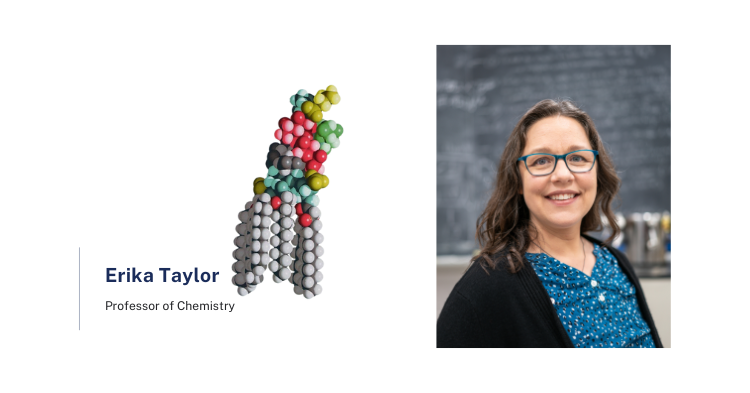
Witnessing racial discrimination and food insecurity in her community during childhood, Professor Erika Taylor developed an enduring commitment to supporting students from diverse backgrounds. Now, she wears many hats including: Professor of Chemistry, Environmental Studies, Integrative Sciences, Molecular Biology and Biochemistry, director of the McNair Program and WesMaSS (Wesleyan Mathematics and Science Scholars). At this point, it might be easier to list what she doesn’t do at Wesleyan!
Taylor has spent over 17 years working with McNair students, crafting programs and initiatives that transform who gets to participate in scientific advancement. “Growing up food insecure for a significant amount of time as a child, while also witnessing racial injustice in a very white community where the Klan had a considerable presence – these experiences shaped my understanding of both privilege and exclusion,” Taylor reflects. Despite being a child of the 1980s-90s, she witnessed crosses burned on the yards of her biracial and African American friends, experiences that would later fuel her commitment to diversity in science.
Her journey took a transformative turn during her time at Albert Einstein College of Medicine in the Bronx. There, as a white American researcher in an incredibly diverse environment, Taylor discovered the power of multicultural collaboration in scientific problem-solving. “Between the amazing dishes I got to try when we had departmental pot-lucks, to enjoying watching the international rivalries of World Cup Soccer,” she reminisces, “I saw how our different experiences really helped us to solve problems differently and working together we definitely seemed like an unstoppable team.”
Taylor’s research focuses on biochemistry, but her impact extends much beyond the lab. Since 2017, she has played a crucial role in shaping the McNair Program at Wesleyan, and served as the faculty director from 2018 to 2023, implementing significant changes to better support scholars. One of her key innovations was establishing a spring course for sophomore and junior McNair students, helping them prepare for research success and graduate school applications well in advance.
The McNair Program, named after Ronald E. McNair, Ph.D., who perished in the Challenger Space Shuttle disaster, requires that two-thirds of participating students come from first-generation, low-income (FGLI) backgrounds. Taylor has expanded the program’s reach by mentoring “McNair-like” students who may not meet the official criteria but need similar support.

But perhaps Taylor’s most significant contribution has been her work with WesMaSS, with whom she served as director since 2024. The program goes beyond traditional academic support, creating what Taylor calls “a sense of belonging at Wes.” Through carefully structured mini-courses, personalized mentorship, and strategic resource allocation, WesMaSS helps students navigate both the academic and social challenges of pursuing STEM at a predominantly white institution.
“We understand that it can be difficult to navigate Wesleyan as a FGLI student,” Taylor explains. Her solution? Creating intentional communities within STEM courses. When possible, she works with faculty to ensure students aren’t isolated as the only person of their identity in a class, while simultaneously helping form study groups that become support networks.
In her own chemistry courses, Taylor’s commitment to inclusion manifests in unique ways. Her Environmental Chemistry class, for instance, doesn’t just cover reaction kinetics and molecular structures. Students explore how chemical hazards disproportionately affect low-income communities, connecting scientific principles to real-world social justice issues.
“Science doesn’t exist in a vacuum,” Taylor often reminds her students. By creating supportive communities, connecting chemistry to social issues, and fostering diverse collaboration, Taylor isn’t just teaching science – she’s reshaping who gets to be a scientist. Her work demonstrates that when we make science more inclusive, we don’t just help individual students; we enhance the entire field’s ability to solve complex problems and serve society. As she continues to mentor the next generation of scientists, Taylor’s impact ripples far beyond Wesleyan’s campus, creating a more equitable and innovative scientific community for the future.