
Next time you’re racing through Hall-Atwater for your 1:20pm lab, take a second to glance at the words lining the walls of the Mukerji lab: “Think like a proton, always positive”. For 30 years, Professor Mukerji has been a source of encouragement for her students, inspiring them to consider the way science could be. From her instrumental role in creating the College of Integrative Sciences major (CIS) and Inclusion in STEM (now WesWAVES) to her countless research contributions in Molecular Biology and Biochemistry (MB&B), Professor Mukerji has truly made her mark on the Wesleyan community.
The CIS major was established in 2014, with the recognition that STEM research often pushes the boundaries of one individual field. When I asked Professor Mukerji about her motivation behind creating such an interdisciplinary major, she explained there was an overall “recognition that the problems that your generation will face, much more so than mine, are really difficult problems, like climate change and diminishing resources.” Therefore, she acknowledges that, as a professor, part of her role is “making sure we are training the next generation of scientists to be able to think flexibly across all of these different disciplines and to be able to fashion different solutions.” In addition, Professor Mukerji hopes that students interested in double-majoring in multiple areas of STEM might find more flexibility with their course enrollments through the CIS major. She explained that the major was designed to allow students to enroll in courses they are interested in while exploring other areas of STEM they may not have had the opportunity to learn about. For prospective or current CIS undergrads, you might be wondering: What’s next for the major? Professor Mukerji aspires to see a future of CIS where: “people are working together to come up with sustainable solutions to some of the problems that we are facing. One of the things that I hope is for my colleagues and students to sort of align their interests in areas that are going to be of benefit to society.”
As for the Inclusion in STEM website, Mukerji explained that the initiative first began in 2020 after the murder of George Floyd, and a movement called Shutdown STEM at Wesleyan, which encouraged students to halt all science-related activities as a form of protest. In a virtual dialogue attended by over 100 individuals and led by then Vice-President of Equity and Inclusion Allison Williams ’81, faculty members were provided with resources to foster inclusivity in the classroom. Mukerji would work with faculty members at Wesleyan to create an online repository, to ensure this information was readily available, and a written pledge, vowing to make STEM more inclusive. Professor Mukerji cited her then co-professor of Special Topics in Integrative Sciences and Faculty Advisor for Wesleyan’s Women in Science Program, Meredith Hughes, as essential to creating Inclusion in STEM, a platform dedicated to featuring diversity at Wesleyan. Mukerji explained: “We wanted to highlight scientists, not at Wesleyan for example, famous scientists who were of different backgrounds, so that’s one part of inclusion in STEM, but another part was to highlight our local STEM faculty, not even just our faculty but local STEM participants and highlight their efforts.” Professor Mukerji aspires for Inclusion in STEM to serve as a source of empowerment for students, who can read about those “who have come before them and who have been successful and maybe read about the challenges they faced and how they overcame them”.

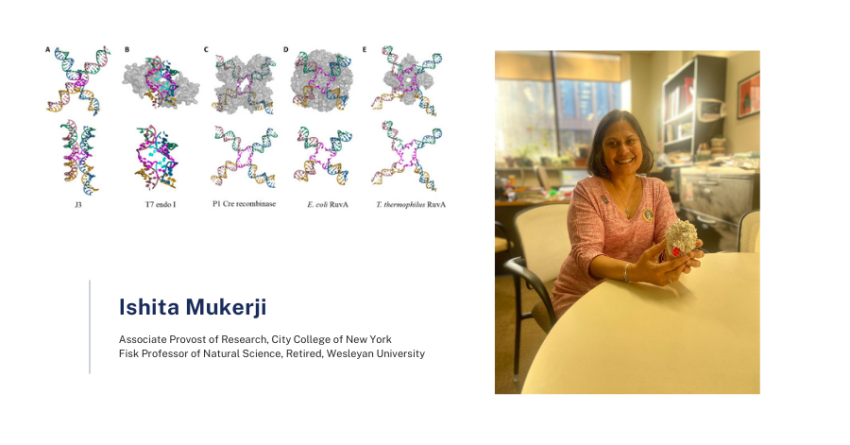
Professor Mukerji’s research is dedicated towards decoding the mystery of protein-DNA interactions. Particularly, her lab focuses on determining how proteins know where to bind on the DNA without sequence recognition. When Mukerji first began her research, little was known about protein-DNA interactions and she was fascinated by the implications of such on understanding gene-regulation. Now, her laboratory is focused on investigating a protein, Msh2-Msh6, “involved in DNA repair that recognizes single-base mismatches”. The Mukerji lab has created complex tools to analyze the DNA structure and specific bases that influence protein binding. During our interview, Professor Mukerji displayed a figurine of the Msh2-Msh6 protein, explaining how a major focus of her studies lies in learning more about how the protein identifies and binds different substrates. Outside of her faculty role at Wesleyan, Professor Mukerji served as a Program Director in Molecular Biophysics at the National Science Foundation. She was particularly excited to have the opportunity to learn and contribute to MB&B research projects occurring nationwide. One of the programs she participated in, Mukerji explained, helped “faculty members at places like Wesleyan get funding and establish their research programs.” This project brought much pride to Mukerji, who noted that she cherished the opportunity to assist new faculty members in their research endeavors.
After a career at Wesleyan defined by innovation and creativity, Professor Mukerji joined City College of New York as an Associate Provost of Research in the spring. Mukerji was particularly fond of the idea of “joining an institution in a leadership capacity, and possibly being able to impact the local community.” She looks forward to continuing her research with her graduate students and exploring the big city. When asked about her greatest accomplishment as a professor, Professor Mukerji expressed with much enthusiasm: “the students.”