If you’re interested in doing something, if you’re interested in going to a conference, if you’re interested in doing experiments, if you’re interested in joining a lab, just go out and ask and push for it. It takes a lot of courage, but you learn how to do it better as you go along.
Fa’alataitaua Fitisemanu ’24
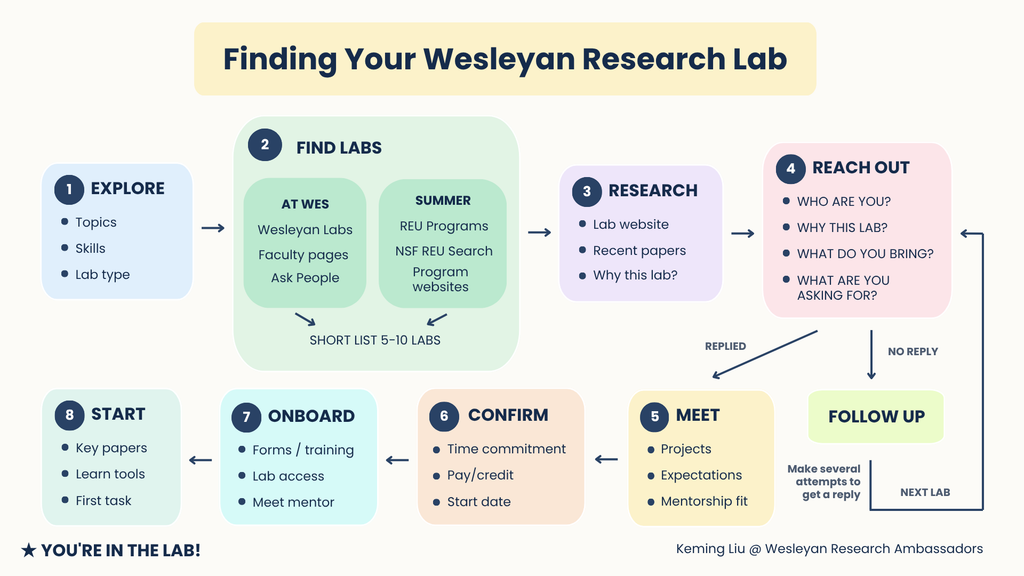
The first step is to figure out what you are looking for. Here are a few questions to get started:
- What field(s) am I most interested in?
- What type(s) of research do I want to do?
- What type(s) of lab do I want to join?
- What research skills do I have and what am I interested in learning?
- How does research fit into my career goals?
Browse research resource guides for each major/discipline set up by the library:
- Biology
- Chemistry
- Computer Science
- Earth and Environmental Science
- Mathematics
- Molecular Biology and Biochemistry
- Physics
- Psychology
Read about what’s happening at Wesleyan:
On Campus
All faculty with research groups in STEM at Wesleyan are listed in our directory. Included in the directory are:
- Departmental affiliations
- Email address and office location
- Research description
- Keywords
- Link to lab or faculty webpage (coming soon!)
- Link to Google Scholar profile (coming soon!)
- A one sheet research profile (coming in 2027!)
Alongside the directory, we publish lab availability listings updated each semester. The current spreadsheet is available here.
STEM seminar courses where faculty, graduate, and honors students present their ongoing research are available in many departments: CIS 221, CIS 222, MB&B 209, PHYS 531, PHYS 532, BIOL 557, BIOL 558, CHEM 557, CHEM 558, E&ES 557, E&ES 558, MB&B 557, MB&B 558, NS&B 557, NS&B 558. Individual lectures may be open to interested students; reach out to the instructor to inquire.
Ask upperclass students such as undergraduate course assistants, student club leaders, and STEM Ambassadors, for recommendations.
Off Campus (Summer)
Search online for potential summer research opportunities off-campus.
- Pathways to Science: https://www.pathwaystoscience.org/
- REU Finder: https://reufinder.com/
- Zintellect: https://zintellect.com/
- Google “summer research opportunity undergraduate”
- Consider universities local to your hometown
- Listings specific to international students:
If an REU or other funding is not available, you may consider a Wesleyan Summer Grant. Fellowships provided by the Bailey College of the Environment and Wesleyan McNair Program may also be used off-campus.
Make a short list of 5-10 labs to look into more in depth.
- Visit the lab or faculty webpages to discover their research interests and ongoing projects.
- Read recent journal articles published by the PI and lab group.
- Do a literature review based on the PI’s research description.
- Attend a poster session or lecture by the PI or their current graduate and undergraduate students.
- Take a class with the potential PI.
Guidelines for emailing a lab
- Address the PI with respect. Do not address them by their first name, a nick name, or a casual greeting such as “Hey Prof!” Even if you know them from class, a friend, or an intramural sport, use their title (Dr. or Professor) and surname as you would for a job interview or similar engagement.
- Personalize the request. Do not send identical emails to all the labs on your short list. Instead, explain why you are interested in their research. Ask questions specific to a paper you read or a lecture you heard. Mention where or from whom you learned about their lab, methods, or goals. Describe how working with them would fit into your own plans for your major, the summer, or post-Wesleyan pursuits.
- Plan to meet on their schedule. Offer to come to office hours or a lab meeting. Ask if there are any upcoming seminars or lectures you might attend to learn more. Ask if they have any grad students or senior undergrad researchers you could meet with or if there might be a good time you can come by the lab to see them in action.
- Be clear with your request. Describe your skill level and what you hope to learn. Tell them your preferred timeline, for example, to join the lab this semester or to stay over the summer. Suggest concrete goals, such as to attend a conference, complete an honor’s thesis, or author a publication. If you are new to research and don’t know what to expect or you can only commit to a short term project because you’re going abroad, be up front about it. PIs are looking for all types of students.
Congrats, you have an appointment! Now, be sure to prepare for the meeting.
- Be polite and curious. You are both getting a feel for your interests, backgrounds, and personalities.
- Engage with the research. Ask about potential projects for students like you.
- Come with questions. Think about what you need to know to move forward.
- Listen and take notes. Make sure you understand the plan.
It is unusual for faculty to permanently accept you into their lab group after one meeting! Often the meeting ends with next steps, such as attending lab meetings, writing a draft project proposal, or participating in a training session. You may be asked to ‘try out’ a lab and shadow a current student and meet a few times over the semester to evaluate the match. Labs handle personnel schedules and training differently; if you have questions, ask.
Congratulations, you have been invited to join the lab! Before you start, make sure you understand the expectations.
- Verify your time commitment and expected schedule. These will look differently during the academic year versus the summer.
- Discuss options for funding and/or course credit.
- During the academic year research tutorials may be taken for .25, .5, or 1 credit. The expectations for your tutorial should be part of the record.
- During the summer, research fellowships are available through the CIS, COE, CoDES, QAC, McNair, GISOS, and other internal and external programs. Be sure to discuss and confirm application requirements such as a project proposal and letter of reference with your mentor.
- Set your start date and plan for any required safety or equipment trainings prior to starting in the lab. Make sure you know the requirements for personal protective equipment (PPE).
- Ask about keycard access to lab and equipment spaces.
Safety Training and Access
Laboratory Safety Orientation – CHP & Hazardous Waste (“General Lab Safety”)
- This introductory lab safety course is required for all student researchers working in wet labs.
- ALL students in Biology, Chemistry, E&ES, MB&B, NS&B, and Physics labs must take this course even if their project is computational.
Chemical Laboratory Safety – Fundamentals
- Required for students working in Chemistry, Physics, and Earth & Environmental Sciences (E&ES) laboratories.
- Topics include: chemical hazards, PPE, fume hood use, and general safe work practices.
Biological Safety – Undergraduate Research
- Required for students working in Biology, Molecular Biology & Biochemistry (MB&B), and Neuroscience laboratories.
- Topics include: biological hazards, exposure routes, waste handling, and spill response.
Additional Lab Safety Modules
Check with individual labs to determine requirements.
- Animal Safety
- Biosafety Level 2 (BSL2)
- Blood Pathogens
- Laser Safety
Responsible Conduct of Research (RCR)
- Wesleyan requires all students conducting any kind of research on campus to complete this free online training session through the CITI program.
- Go to: https://www.citiprogram.org/
Under “Log in through my institution” click “Log in via SSO”
Click on Wesleyan University then follow the instructions to set up your account Under “Main Menu” select “Add a Course or Update Learner Groups”
Select “Yes, I need/want to take the course on Responsible Conduct of Research (RCR)” then click “Next”
Complete this course early within the semester in which you are conducting research.
For more information about Wesleyan’s RCR policy and plan, please visit http://wesleyan.edu/acaf/support/RCR.html.
Lab Access
- To gain access to your new lab, email a request to the department AA including the room name and number, your name and WesID, and your start date. Copy your faculty mentor to verify approval.
Course Credit and Payment
Research Tutorials
- During the academic year, student researchers enroll in Advanced Research Tutorials numbered 423 (Fall) and 424 (Spring) for a range of credit based on the time commitment and project.
- Please see your individual mentor/department for the specific process.
Summer Research Credit
- All on campus summer research students funded through the College of Integrative Sciences, the Bailey College of the Environment, or WesMaSS are enrolled in CIS/ENVS 493Z for credit.
- Alternatively funded students may enroll at the request of their mentor.
Fellowship Payments
- Research students funded through a fellowship are paid by default, through a digital payment called Concourse (similar to Venmo). Concourse is a Digital Payment Solution through JP Morgan Chase. Concourse is a secure and easy way to pay our students through supplier invoices where we don’t need to collect or store banking information. Students receive an email with instructions on how to easily connect their bank account to the Concourse platform, and funds will be deposited within one business day.
- Summer research students will receive two lump-sum payments, one in June and one in July.
Payroll
- Research students who are funded through federal grants will be paid hourly.
- Students are hired through Workday and time is recorded through Workforce Time.
- If this is your first on-campus job, visit the Gordon Career Center Campus Employment for Students website and follow the process for “First Time Employees”. You must have your required IDs with you on campus and you must meet with Payroll in person. You are not allowed to begin work until you have completed the hiring process.
Final steps prior to starting in the lab
- Verify you have submitted all paperwork and completed all required safety trainings.
- Dress appropriately for the lab, including required PPE.
- Prepare for your first day with any recommended readings or online modules.
- Know safety protocols for the building space(s) and individual lab(s). Have an emergency contact on file. Do not work alone.
- Remember that in STEM, questions are always encouraged! Speak up if you aren’t sure about something or need them to repeat an explanation or direction.
🌟YOU DID IT!🌟
Frequently Asked Questions
1. What are the requirements to do research?
The only true requirement is interest. Some professors prefer students to have taken certain classes, but do not be afraid to reach out and ask. You can also check to see if they’ve specified anything on the availability list below.
OCTOBER 2, 2026 Lab Availability
2. How do I prepare for research at Wesleyan?
- Take introductory classes such as intro bio lab, intro chem lab, intro to programming, etc. to build a skillset.
- Read articles of the professors you are interested in to see how they approach a research question.
- Attend research seminars. You can find lectures (and many other events!) at our NSM Events Calendar. External speakers are hosted by Wesleyan research groups, and many departments have seminars you can ask to attend to hear from internal speakers (grad students, honors students, and faculty).
3. What should I bring to lab group meetings?
We suggest a notebook and pen. Don’t open your laptop throughout the meeting. If a paper or other review materials were assigned, be sure to read them, and bring a copy, especially if you have questions.
4. How do I get involved in research as a first year?
Email email email Professors! Do not get discouraged if you get no reply; it is acceptable to follow up up to three times. If the first one or few say they do not have space, email other professors. Be persistent and polite.
5. What do we do if we have emailed a professor/lab director several times and have yet to get a response? Should we try to get in touch with them in person?
You could go to office hours, explain you are interested in their research and ask if there are opportunities available. Do not approach their office or lab without an invitation (such as office hours) or an appointment.
6. If I’m trying to reach a professor, is it possible to find their office hours & location online?
We are actively working on a research directory linked here. All faculty at Wesleyan have a profile page you can find by searching “[Faculty Name] Wesleyan” or typing “https://www.wesleyan.edu/about/directory/profile.html?id=[username]”.
Do you have more questions about research at Wesleyan? Please email scienceresearch@wesleyan.edu.
Our toolbox is updated regularly. If you have an update or resource to share, please send the information to adane@wesleyan.edu.