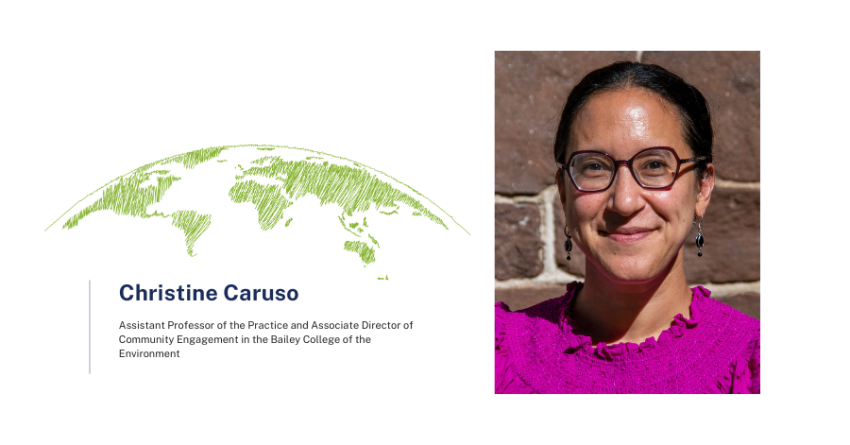
When we go out and engage with their community, Associate Professor of the Practice Christine Caruso wants us to ask ourselves a question:
How can we, as humble citizens, go forth in the world and be in relationship with other humble citizens to make our environments better?
This question forms the basis of parts of Professor Caruso’s work–in her research, her teaching, and her time at Wesleyan. She currently teaches a Community-based Participatory Research (CBPR) class in the Bailey College of the Environment, where she is also the Associate Director of Community Engagement. In this class, students learn to do research in, for, and with their communities, with an emphasis on researching initiatives that promote environmental justice. She hopes that students find some way to resonate with and get involved with community work and research–to find a way to do their part in the monumental task of environmental justice.
In engaging in environmental studies, she wants Wesleyan students to consider not just how systems of pollution and global warming impact communities, but also how people’s food environment affects them. Food justice, a kind of environmental justice that focuses on how people access and encounter food, is at the heart of Caruso’s studies. Through the other class that she has taught, “American Food Systems”, she wants students to understand the systems that bring them food on campus (their present “food environment”). Thus, they can apply that analysis to other communities, such as the food environment that exists within the broader Middletown area.
Both her current research and her CBPR class examine the school meal programs in Middletown, statewide, nationwide, and internationally. Specifically, Professor Caruso works with the school food director of the City of Middletown in order to research stigmas surrounding the school food workforce–a “feminized and minoritized workforce” that is often looked down upon while operating in a high-stress environment. Media has historically portrayed these key stakeholders in a negative light (i.e, Lunch Lady from SNL or Doris from The Simpsons), and yet there is very little research on the wide-reaching impact of those stigmas and the workforce itself, with research instead being directed towards production and distribution of school lunches. The food service workforce has many issues that are unique to their positions, but in understanding those issues, Caruso hopes to better understand the larger issues at play in the entire food system.
For Caruso, highlighting and engaging with the community is a key part of promoting inclusion in STEM. When thinking about what the individual can do to contribute to an inclusive environment, “it requires a lot of reflection, and it requires all of us to participate…creating enough space and enough safety for people who may have historically felt marginalized or excluded to take part in the work”. This is what it means to be a humble citizen in relationship with other humble citizens–to take action to promote an equitable community where everyone can have access to the work that we are doing. To properly engage with a community in the spirit of inclusion means authentically building bridges, sharing resources (whether that be materially or knowledge-based), and repairing historical harms. Professor Caruso knows that to make a difference in inclusivity across our communities, we all have to participate.