
Stem cells are a special type of cell that have a unique ability to be reprogrammed into nearly any cell in the body. Like the stem cells she now studies, Dr. Alison O’Neil’s career has always been guided by the confidence to reprogram its direction. However, long before she became a stem cell scientist, Dr. O’Neil learned to trust her instinct to leap into new questions, new fields, and new versions of herself.
Her curiosity began in high school when she entered a pilot program for scientific research and world health. There she learned two things—she never wanted to conduct research with animals, and that scientific research was an actual career she could pursue. After high school she attended Binghamton University where she took Advanced Proteomics and Genomics and met her first graduate student who led the lab portion of the course. “I loved being in the lab… We studied the stress response of Arabidopsis thaliana. It was the first plant to have its genome sequenced,” she recalled with excitement. From then on, she was set on finding a job where she could do lab work.
And in fact, she landed a job at Ligocyte Pharmaceuticals. Ligocyte was where Dr. O’Neil’s interdisciplinary instinct truly began to take shape. It wasn’t a place defined by rigid mentoring structures, but by people who were generous with their knowledge and a young scientist who wasn’t afraid to ask for it. “No one will teach you unless you show you want to learn,” she said. And she did so boldly. O’Neil asked everyone around her if she could watch, help, or be taught, not because she had to, but because she wanted to understand every technique, every tool, every experiment happening in the building.
The work was diverse: from virus-like particles to vaccine platforms, protein purification, and chemistry she had never seen before. Everyone did different things, and rather than being intimidated, O’Neil treated it like an opportunity. She moved from bench to bench, learning from chemists, virologists, molecular biologists, and engineers. The encouraging, patient, and collaborative Ligocyte team did more than teach her techniques, they gave her confidence that she could enter any field, learn its language, and make meaningful contributions. “It wasn’t one mentor,” she emphasized. “It was the whole group.” A community of scientists who took her seriously, even though she was the youngest person there. A workplace where ideas were shared freely, skills passed between colleagues, and curiosity was a kind of currency. And ultimately, Ligocyte was the place that convinced her she could pursue a PhD. Their belief in her fueled her own.
When O’Neil entered her PhD program at Montana State University, she found herself in a department that was unusually well-funded and ambitious. Instead of being intimidated, she recognized something familiar: a community of people who were excited about their science and willing to share it. She leaned into that energy, asking questions freely, offering help wherever she could, and learning side-by-side with people who valued her initiative. And with that, she defended her PhD thesis on engineering nanomaterials using self-assembling viral protein cages. The room was filled with people who had shaped her journey. Her family sat alongside former colleagues from Ligocyte who had once taught her the basics of industry-scale science and encouraged her curiosity. Looking around that day, O’Neil felt both proud and humbled. She realized that her confidence to ask others to teach her, her instinct to jump in and help, and her deep belief in collaborative science were not just habits but they were the very forces that had carried her through. “I just think in a world, especially now, where everybody’s in their own little bubble, if you can break into somebody else’s, they really appreciate it,” she reflected.
In 2012 , just around the time O’Neil graduated from MSU, Shinya Yamanaka won the Nobel Prize for inducing stem cells. She recalls the buzz surrounding this revolutionary discovery and thought to herself, “I’ve got to do this. This, it just was something I didn’t know about and so I had to figure out how I can learn how to do this.” Her doctoral committee member had given her an important piece of advice, to do her postdoc in something new, thinking about the lab that she would want to have down the line. That was the pivot point. She reprogrammed her own trajectory, throwing herself into the challenge of entering a field that was exploding with excitement and competition. Landing a stem-cell postdoc was not easy; she sent applications, followed leads, and kept pushing even as rejection letters piled up (Advice from the woman herself: reach out to administrative assistants rather than the PI’s that have a million things on their to-do list!). But her persistence, the same drive that once carried her through Ligocyte and her PhD, paid off.
Eventually, she secured a postdoctoral position at Harvard, where she found herself surrounded by scientists who were redefining developmental biology in real time. The pace was fast, the questions were big, and the expectations were high—but instead of being overwhelmed, O’Neil thrived. Harvard taught her how to think more boldly, how to present new perspectives that matched the scale of her curiosity, and how to navigate a research environment where everyone was pushing the boundaries of what seemed possible. It was the kind of training that didn’t just sharpen her skills; it crystallized the kind of scientist she wanted to become: one who meets new fields head-on, reprograms herself when curiosity calls, and embraces challenge as an invitation rather than a barrier.
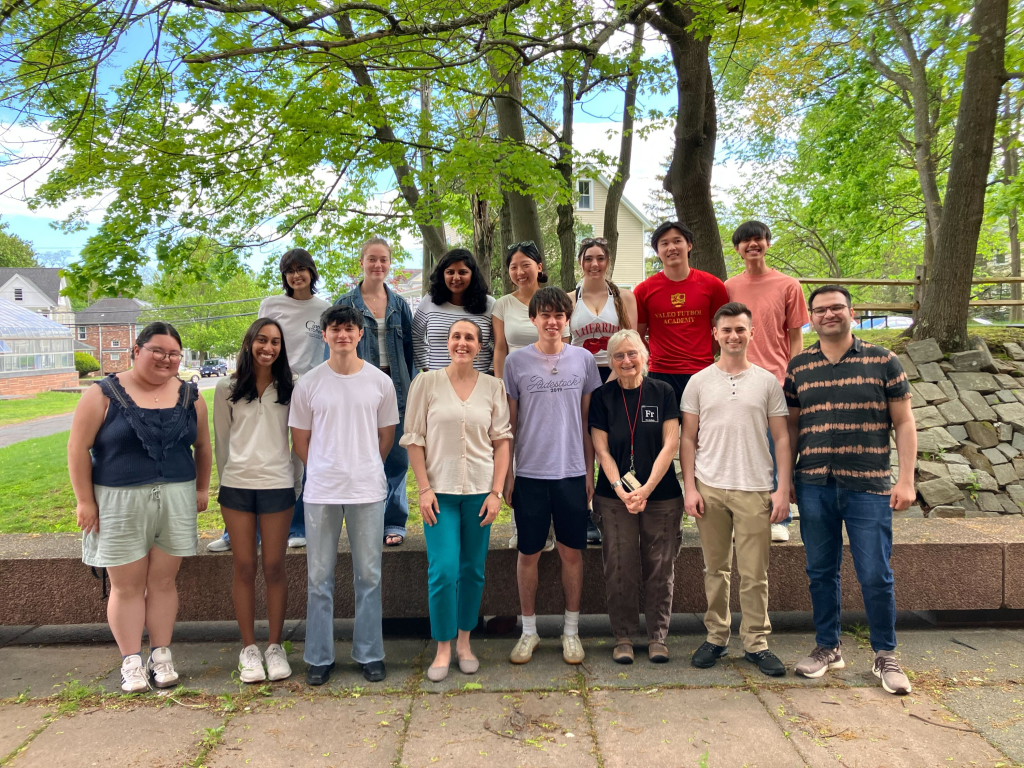
At Wesleyan, she has been able to become that scientist, a neurochemist and stem cell biologist. Dr. Alison O’Neil leads a lab shaped by every leap she ever took. Her research now centers on using stem cells to ask big questions about aging, neurodegeneration, and the molecular signatures that define our brains over time. In many ways, it’s the culmination of all her past disciplines—the molecular precision of plant proteomics, the collaborative energy of her pharmaceutical work, the materials engineering of her PhD, and the bold experimental mindset she honed at Harvard. But what stands out most in her lab is not just the science, it’s the culture. O’Neil is intentional about building a research environment where curiosity is encouraged, questions are welcomed, and students feel empowered to learn from one another the way she once learned from everyone around her. She often jokes that she “accidentally became a neurochemist,” but her work reflects something deeper: a scientist unafraid to shape her own path and help others do the same.
In a time when science is increasingly shaped, and sometimes constrained, by politics, O’Neil is both pragmatic and hopeful. She’s acutely aware that research funding can rise and fall with political tides, and that public trust in science must be actively cultivated. Her perspective is clear: all sciences are interdependent and cutting one weakens them all. Yet she remains committed to moving forward by doing what she has always done—staying adaptable, staying collaborative, and staying focused on the questions that matter.
Looking ahead, O’Neil is excited about the next “fork in the road,” whatever it may be. Whether it involves new stem cell technologies, emerging models of neurodegeneration, or mentoring the next generation of interdisciplinary thinkers, she approaches the future with the same instinct that has guided her career from the start: follow curiosity, take the leap, and trust that reprogramming of cells, of ideas, and of oneself, can lead to something extraordinary.