
Now an Assistant Professor of Computer Science and Design and Engineering Studies, Sonia Roberts’ path to robotics was anything but conventional. She entered Vassar College planning to study history or psychology, but her enjoyment of programming her TI-83 calculator and web design led her to courses in computer science and an eventual interdisciplinary Cognitive Science major. “I wanted to understand behavior and intelligence, like why creatures do the things that they do,” she explains. A pivotal course called Perception and Action introduced her to robots as models for understanding biological systems, sparking her interest in using robots to understand behavior.
After graduating from Vassar College, she spent two years at the Janelia Farm Research Campus, working on building a rough behavioral map of the fruit fly brain. But neuroscience felt limiting. “I think a lot of behavior is not in our brains,” she reflects. “I couldn’t look at the whole system and its environment together from a neuroscientific lens.” This frustration led her back to robotics, and to a PhD in Electrical and Systems Engineering at the University of Pennsylvania–a dramatic field change that required mastering advanced mathematics she’d never encountered.

“It was painful,” Roberts admits about the transition. She had to self-teach differential equations and control theory while taking the graduate courses for which those things were prerequisite knowledge. Her advice to current students reflects this hard-won wisdom: “Take more math. You will never regret having learned math.” At University of Pennsylvania, Roberts worked with Professor Dan Koditschek in the GRASP Lab to develop a reactive controller to reduce the energetic cost of transport for legged robots on sand. Roberts was drawn to the Koditschek lab for their use of dynamical systems theory to understand robot behavior.
Dynamical systems theory uses mathematical equations to describe how things change over time. Roberts illustrates this with a simple example: a spring, which, when pulled and released, oscillates and eventually settles back to its original position. “You can describe this motion with just two equations: one that is a function of position and one of velocity,” she says, noting that these same principles can be applied to far more complex systems. “Most systems in the world can be described in kind of similar ways,” Roberts explains, whether it’s a spring, a cycle of steps in walking, or even a memory forming in the brain. By thinking in terms of how systems settle, oscillate, or behave chaotically, she’s able to use the same mathematical language to analyze both robotic and biological behavior, seeking to understand not just how robots move, but how any agent–human, animal, or machine–interacts with its environment over time.
Her PhD work on robots running across sand highlighted the limitations of traditional, rigid-bodied machines when faced with unpredictable, real-world environments. “Sand is like the worst spring. It just collapses underneath you,” she explains, noting that while you can mathematically model sand’s behavior, a robot can’t reliably predict or adapt to its shifting surface in real time. This is because the behavior of the sand depends heavily on things that vary a lot in the wild, even from step to step–like how compacted the sand is or how much of it is made of larger versus smaller grains. This realization fueled her interest in soft systems, where a robot’s flexibility, stretch, and resilience can be designed to handle uncertainty and shift some of the complexity from the robot’s control system to its physical materials.
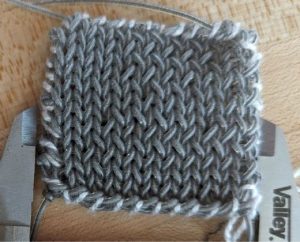
At Wesleyan, Roberts leads an interdisciplinary lab at the intersection of computer science, engineering, and textiles, developing soft, knitted sensors and actuators that can be incorporated into robot bodies, wearable devices, or even architectural structures. She and her students work with Wesleyan’s state-of-the-art computational knitting machine–the only one of its kind open to all undergraduates at a liberal arts college–making the lab a hub for collaboration between scientists, engineers, and artists. This openness means that a student interested in robotics, a designer exploring textile art, or a biologist studying animal movement can all find a home in Roberts’ lab, sparking creative cross-pollination. Projects range from building open-source lizard-inspired robots for biology research to developing knitted sleeves that sense pressure or movement for both human and robotic limbs. By welcoming students from diverse academic backgrounds and encouraging hands-on experimentation, Roberts’ lab embodies the spirit of interdisciplinary innovation, demonstrating that breakthroughs often happen at the seams between fields.
“Don’t let yourself be siloed,” she tells students. Her own journey–from history, cognitive science through neuroscience to engineering–demonstrates how diverse interests can converge into innovative research. Now at Wesleyan, where yarn meets algorithms, Roberts is quite literally spinning the future of robotics.